

In Boardroom Volume 11, FMI and Oliver Wyman share insights to help food industry leaders cut through complexity, understand the patterns shaping technology, consumer shopping, loyalty, and the workforce, and lead with greater clarity in a rapidly changing environment.
By Mark Baum, Chief Collaboration Officer & Senior Vice President, Industry Relations, FMI
In the food and grocery retailing industry, the pace of change rarely slows. Competition sharpens technology advances, consumer expectations evolve, workforce dynamics shift, and regulatory pressures intensify, often all at once. Up close, 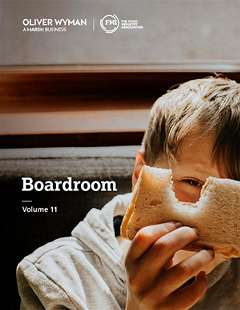 the industry can sometimes look reactive and fragmented. When you step back, however, clearer patterns emerge. Those patterns are exactly what Boardroom Volume 11 is designed to surface.
Produced annually in partnership with Oliver Wyman, Boardroom is a journal designed to help senior leaders cut through noise and focus on what truly matters. The 2026 edition, reflects an industry at an inflection point. Not because the fundamentals of feeding families have changed, but because the environment surrounding those fundamentals has accelerated in complexity and consequence.
Across its articles, several signals repeat. Technology has moved from enabler to catalyst. Artificial intelligence, automation, and data usage are no longer supporting functions. They are reshaping how decisions are made, how work is organized, and how value is created across the entire food industry ecosystem. The discussions on pragmatic AI adoption and category management are particularly instructive, emphasizing discipline, guardrails and real-world execution over hype.
Cybersecurity emerges as another defining theme. The message is clear: cyber risk is no longer an IT issue. It is a business continuity issue that touches every function and every partner in the value chain. The work highlighted in this volume reinforces why FMI has characterized cybersecurity as a noncompetitive issue, one that demands shared standards, preparation, and collective action. FMI is also establishing a Cybersecurity Oversight Committee of the Board.
Volume 11 also underscores a shift in how we think about people and work. The future of work is rapidly changing. The nature of the work itself. The workforce. The workplace. Roles are changing, expectations are changing, and leaders are being asked to design organizations that support continuous learning, adaptability, and well-being. The workforce discussions are moving beyond staffing challenges to address culture, capability building, and longer-term implications including the impact of AI.
Consumer behavior remains the most dynamic force of all. Health and well-being, omnichannel engagement, transparency, affordability, and personalization intersect in new ways. The articles remind us that understanding consumers is at the very heart of our business. It is an ongoing discipline that requires humility, investment, and constant recalibration. Tapping the ever-changing consumer zeitgeist remains the number one ingredient for success in the marketplace.
Taken together, Boardroom Volume 11 tells a consistent story. The food industry is not standing still. It is being reshaped by interconnected forces that demand inspired leadership, clear priorities, and strong cross functional collaboration.
That is where FMI’s role becomes most important. Through advocacy, collaboration, and education, FMI works to help members interpret these signals early on and act swiftly and with confidence. Boardroom is one of the clearest expressions of that commitment. It is not just a collection of articles. It is a leadership tool for navigating what comes next.
 Industry Topics address your specific area of expertise with resources, reports, events and more.
 Our Research covers consumer behavior and retail operation benchmarks so you can make informed business decisions.
 Events and Education including online and in-person help you advance your food retail career.
 Food Safety training, resources and guidance that help you create a company food safety culture.
 Government Affairs work — federal and state — on the latest food industry policy, regulatory and legislative issues.
 Get Involved. From industry awards to newsletters and committees, these resources help you take advantage of your membership.
 Best practices, guidance documents, infographics, signage and more for the food industry on the COVID-19 pandemic.
