

FMI’s GroceryLab is designed as a true learning environment to tackle the fundamental challenge of how the grocery industry can better serve consumers by advancing the art and science of producing, delivering and selling food.
By: Doug Baker, Vice President, Industry Relations, FMI and Mark Baum, Chief Collaboration Officer & Senior Vice President, Industry Relations, FMI
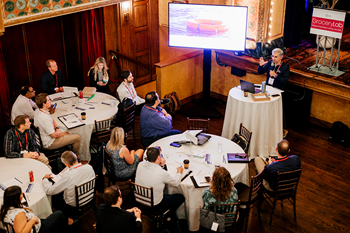 We named our newest event experience GroceryLab very intentionally.
Not as a metaphor, but as a commitment to treat the future of our industry as something to be actively tested, challenged and refined in real time.
As we learned in concepting this experience, a true laboratory is not a black and white environment. Instead, it’s about experimentation; it’s about trying new ideas in a safe, critical environment learning as much from what doesn’t work as from what does. And in an industry as complex, interconnected and essential as food retailing, that mindset matters.
At its core, GroceryLab is designed to help us address one fundamental challenge: How we better serve consumers by improving the art and science of producing, delivering and selling grocery products.
That’s a big ambition, and it requires us to unpack some very real tensions, or as we call them, friction points.
Solving for the Consumer Without Creating New Friction
We know the expectations in today’s shopping experience are deeply human and often competing.
Consumers are asking us to:
- Keep food affordable;
- Personalize health and nutrition;
- Deliver new taste experiences;
- Operate ethically and sustainably; and
- Ensure product availability with confidence.
Individually, each of these is a challenge, and together, they require balance.
The real test isn’t just solving a pain point – it’s doing so without introducing friction somewhere else in the experience. That’s where thoughtful experimentation becomes critical. And increasingly, where technology enters the conversation.
From Efficiency to Transformation: Rethinking AI
One of the clearest themes emerging from GroceryLab is a fundamental shift in how we think about AI. For years, the conversation has focused on efficiency, namely centered on cost savings, automation and productivity gains.
What we are seeing now is a pivot toward growth, and more importantly, toward transformation. AI is not just a tool to optimize existing processes. It is becoming a driver of new ideas, new business models and new strategic possibilities regarding the most complex challenges our industry faces.
And it requires a broader lens.
Expanding the Definition of Retail
Retail doesn’t start at the shelf. It’s the intelligence behind what gets shipped; what gets priced; how decisions are made; and how supply chains, data systems and consumer insights come together to shape outcomes.
We recognize the opportunity, and responsibility, for our industry to tell that more complete story, but doing so demands more than technology and therefore is as much a workforce transformation as it is a digital one. The tools may be advancing quickly, but success will ultimately depend on how well people understand, adopt and lead with them.
From Users to Creators
Another clear shift: We are moving beyond simply using these tools to becoming creators.
As platforms mature and the barrier to building drops, innovation is no longer confined to technical teams. The differentiator becomes cultural – who is willing to lean in, take ownership and experiment.
Several of our GroceryLab speakers described this as the “vibe factor,” and it resonates. Organizations that foster curiosity, accountability and momentum will move faster – and go further – than those that don’t.
FMI Designing a True Learning Environment
That’s why GroceryLab is structured the way it is. It is not a passive experience. Each session, each rotation and each cohort interaction is intentionally designed to build on the last. The value comes not just from individual insights, but from how they connect. Because when viewed together, the lessons become something more powerful: A clearer understanding of how to apply these ideas in a practical, integrated way across food industry businesses.
Why This Work Matters Now
All of this is playing out against a rapidly evolving consumer landscape.
We say this all the time internally at FMI: Grocery shopping is no longer a choice between store and screen; it is a seamless blend of both. Consumers are navigating hybrid journeys, moving fluidly between in-store, online and mobile experiences and expecting consistency at every step.
Our recent analysis with NIQ reinforces this shift, as technology is reshaping both the physical and digital shelf, from smart carts to retail media networks. And across all of these trends, one conclusion stands out: Execution is now the differentiator.
Finding the Joy in the Work
There is real urgency in the challenges we face, but there is also opportunity. We find that GroceryLab is about embracing both: It’s about approaching our future with curiosity, discipline and a willingness to experiment, and perhaps most importantly, it’s about finding the joy in that journey.
Because when we get this right – when we combine the art and science of our industry with the courage to lead – we don’t just solve today’s challenges, we define what comes next.
 Industry Topics address your specific area of expertise with resources, reports, events and more.
 Our Research covers consumer behavior and retail operation benchmarks so you can make informed business decisions.
 Events and Education including online and in-person help you advance your food retail career.
 Food Safety training, resources and guidance that help you create a company food safety culture.
 Government Affairs work — federal and state — on the latest food industry policy, regulatory and legislative issues.
 Get Involved. From industry awards to newsletters and committees, these resources help you take advantage of your membership.
 Best practices, guidance documents, infographics, signage and more for the food industry on the COVID-19 pandemic.
