White House Conference on Hunger, Nutrition and Health

As part of the White House Conference on Hunger, Nutrition and Health in September 2022, FMI announced bold commitments acknowledging the important role that FMI and our members - food retailers, wholesalers and suppliers - play in addressing food insecurity and improving health. Here you will find information, messages and resources on FMI’s commitments and the ways our industry is engaging in this important endeavor. The food industry plays an essential role in hunger, nutrition and health with the grocery store as an accessible, convenient community-based destination for feeding assistance, preventive care, nutrition guidance, and nourishing, practical meal solutions.
Food Industry Commitments
WATCH: FMI President and CEO Leslie G. Sarasin as she discusses the ways in which food retailers, wholesalers and suppliers are working to ensure all Americans have access to safe, nutritious food.
Our Collective Report
To support our work with the White House Conference, FMI collected insights, stories, and recommendations from our members – food retailers, wholesalers, and suppliers. The FMI Collective Report puts forth preliminary food industry commitments, recommendations for government actions, and showcases examples from member nutrition, health and well-being initiatives and community outreach and engagement programs that demonstrate the important role the food industry plays in impacting hunger, nutrition, and health.
Stories of Grocery Stores as Destinations for Health & Well-being
Food retailers, wholesalers and suppliers across the country have health and well-being programs for both employees and customers. These programs encourage health and well-being, support disease management, address food insecurity and encourage food safety best practices. Nearly all (84%) of food retailers surveyed by FMI report having established health and well-being initiatives for both employees and customers.
FMI Supporting Pillars
Through FMI’s work on the Bipartisan Policy Center (BPC) Food and Nutrition Security Task Force we are also working with Tufts University to develop recommendations for the White House Conference.
The White House has established Five Pillars to better define the scope of its Conference. FMI will focus on the following pillars:
1. Hunger
Improve food access and affordability
End hunger by making it easier for everyone — including urban, suburban, rural, and Tribal communities — to access and afford food.
Share Industry Examples Of:
SNAP / WIC / Online SNAP
Food Bank Donations
Community Partnerships
Food / Meal Delivery
2. Nutrition
Integrate nutrition and health
Prioritize the role of nutrition and food security in overall health, including disease prevention and management.
Share Industry Examples Of:
Retail Registered Dietitians
Healthy Eating Solutions
Shopping Guidance
MNT / Nutrition Counseling
3. Health
Empower consumers to make healthy choices
Enable all people to make informed healthy choices, increase access to healthy food, encourage healthy workplace and school policies, and invest in public messaging and education.
Share Industry Examples Of:
Family Meals Initiatives
Dietary Guidelines
MyPlate Strategic Partnerships
Food Safety Education
FMI Commitments to Address Hunger and Improve
Food Access, Nutrition, and Health
In the months leading up to the White House Conference on Hunger, Nutrition, and Health on September 28, 2022, FMI convened with members to outline a set of commitments the food industry could support that address food and nutrition insecurity and provide Americans with resources to make informed choices about their eating patterns and overall health. The commitments that follow align with the pillars the White House has identified as priorities for the Conference and beyond to improve food access, reduce diet-related disease, and empower consumers to make healthy choices. Though these commitments are focused on 2023, they serve as a starting point to launch future efforts and help achieve the goals of the Conference by 2030.
Commitment 1: Food Donations
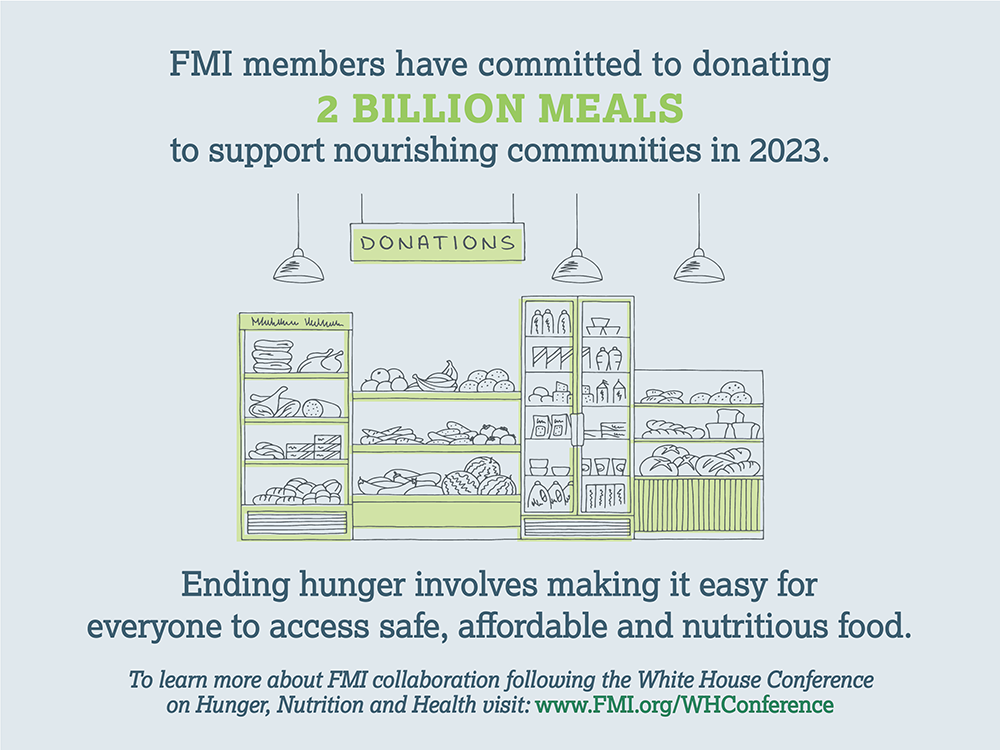
FMI members will donate 2 billion meals in 2023 with the goal of increasing food donations to food banks and other organizations that support nourishing communities.
Commitment 2: Improve Food Access to Underserved Communities
FMI members will commit to robust investment in programs, initiatives, infrastructure enhancements, and partnerships to improve food availability in areas of limited food access. FMI members commit to 2023 benchmarking and annual reporting on these numbers.
Commitment 3: Leverage Federal Feeding and Food as Medicine Programs
FMI members will expand access to and leverage federal feeding programs and Food as Medicine programs in the food retail setting that include nutrient-dense foods. FMI members commit to 2023 benchmarking and annual reporting on these numbers.
Commitment 4: Promote Consumer Education and Transparency
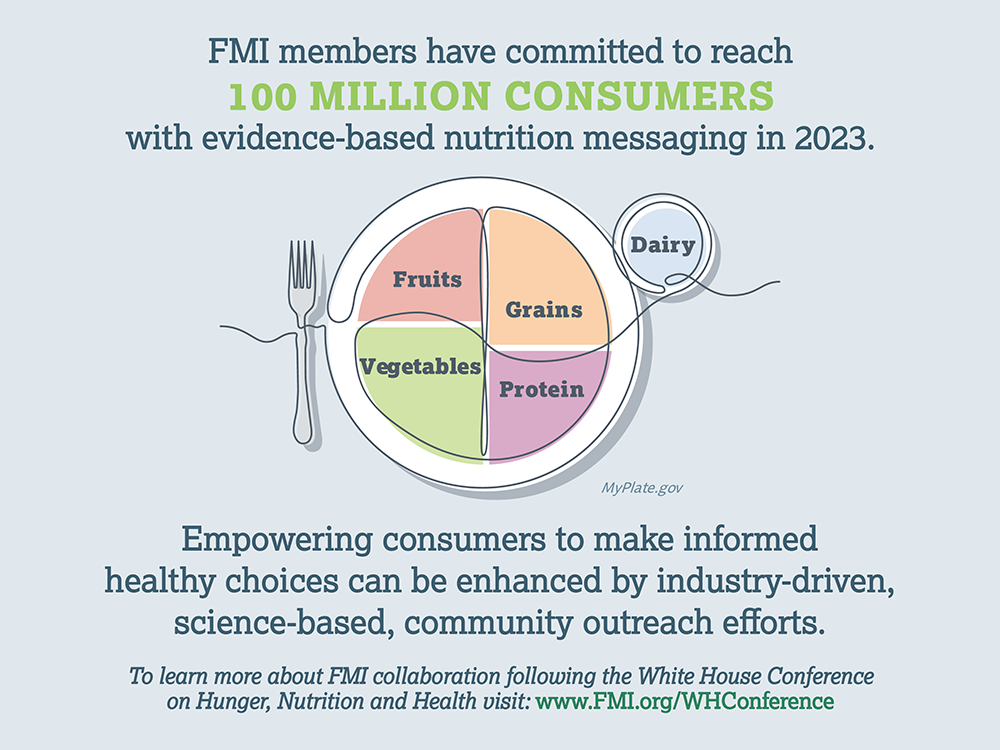
FMI members across the food industry will share evidence-based messages and educational tools for consumers in 2023 to support healthy eating patterns that align with the Dietary Guidelines and federal nutrition guidance. FMI members commit to 100 million impressions/consumers in 2023.
Latest News from FMI About The White House Conference


Questions?
For questions or more information, please contact FMI's Vice President, Health and Well-being, Krystal Register.
Contact Krystal
Questions?
For questions or more information regarding federal legislation, please contact FMI’s Chief Public Policy Officer and Senior Vice President, Government & Member Relations, Jennifer Hatcher.
 Industry Topics address your specific area of expertise with resources, reports, events and more.
 Our Research covers consumer behavior and retail operation benchmarks so you can make informed business decisions.
 Events and Education including online and in-person help you advance your food retail career.
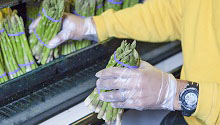 Food Safety training, resources and guidance that help you create a company food safety culture.
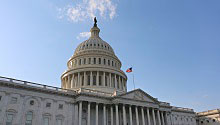 Government Affairs work — federal and state — on the latest food industry policy, regulatory and legislative issues.
 Get Involved. From industry awards to newsletters and committees, these resources help you take advantage of your membership.
 Best practices, guidance documents, infographics, signage and more for the food industry on the COVID-19 pandemic.
© FMI All rights reserved.
Website design by Matrix Group International, Inc. ®
